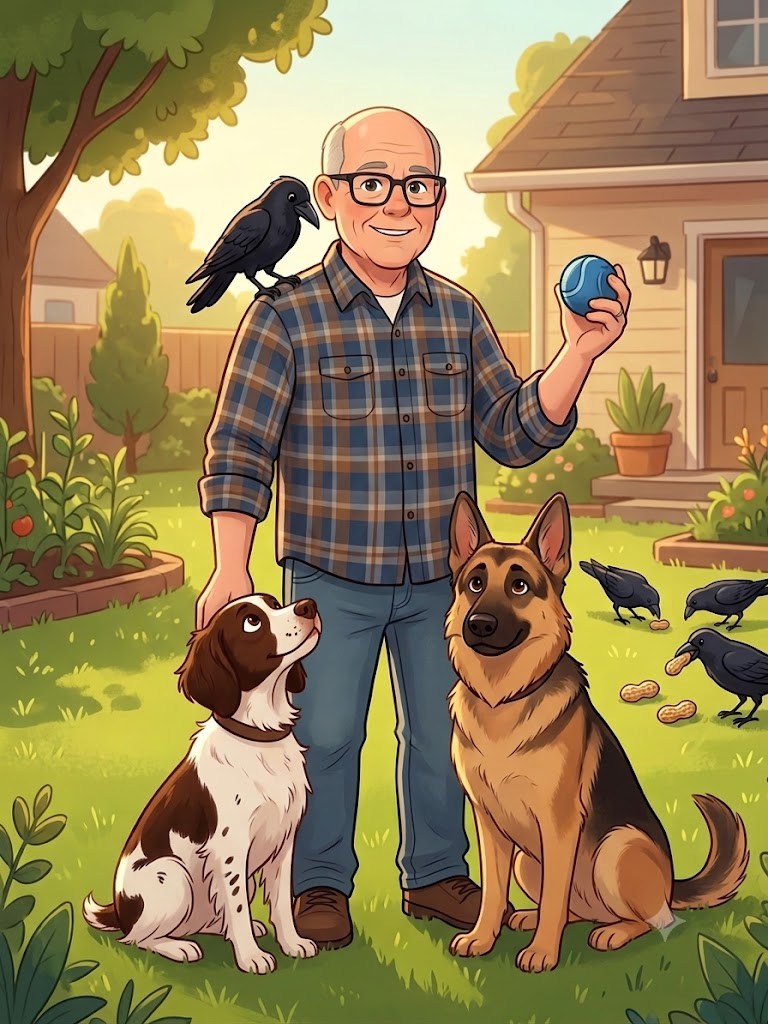
A step-by-step field manual for turning suspicious backyard corvids into loyal, gift-bearing regulars — DFW turf-lawn edition.
Written in loving memory of the man his grandkids called Poppa — who could win over anything with fur or feathers, given enough patience and a full bag of peanuts.
Crows aren't pigeons. Winning one over takes real weeks, not a lucky afternoon — but the payoff is a wild animal that learns your face, remembers you for years, and, eventually, brings things back.
Crows recognize individual human faces and hold the association for years — good or bad. This is the entire foundation of the strategy: be consistent, and the recognition compounds.
Parent crows teach their fledglings who the "safe human" is. Win over one pair and, within a season or two, you may find yourself trusted by their whole family line.
Crows problem-solve, use tools, and hold grudges against people who've wronged them. You are, in effect, being interviewed. Act accordingly.
Once trust is fully established, some crows leave small "offerings" — shiny objects, bottle caps, the occasional dead bug — on porches or windowsills. This is the finish line.
North Texas has its own cast of characters and its own calendar. A few adjustments before you start.
Great-tailed grackles will swarm an open peanut pile in seconds, and DFW has a healthy Cooper's hawk population that hunts songbirds — and will spook crows off a yard entirely if it perches nearby too often.
No digging or caching into dirt means crows will rely entirely on visible surface feeding and any low furniture (fence tops, patio table) you offer as a staging perch.
Juvenile crows disperse from their birth territory around August–October, actively looking for new food sources and turf. Starting then means you're recruiting curious newcomers, not asking established adults to change their habits.
Never leave peanuts out overnight uneaten — it's the fastest way to attract rats and the fastest way to get a complaint. Small amounts, cleared by dusk, always.
Real order, real week ranges. Don't skip ahead — crows notice rushed familiarity and read it as a threat, not a favor.
Goal: set the stage so the first sighting is calm, visible, and repeatable.
Goal: crows learn the food is reliable before they learn anything about you.
Goal: crows start associating your specific presence — not just the food — with safety.
Goal: shrink the safe distance between you and the crows without ever forcing it.
Goal: sustain what you've built — this phase doesn't really end, it just deepens.
After the first few weeks, the whole thing compresses into a five-minute daily habit.
Five checkpoints, five minutes, every single day — this is the whole job once Phase 2 is underway.
Every one of these is normal and every one of these is fixable.
The tells are small and easy to miss if you're not looking for them.
He never once talked about "training" an animal — he just showed up, same time, every time, until the animal decided he was worth trusting. Turns out that's the whole method. For crows, dogs, grandkids, all of it.
December 24, 1952 – April 15, 2024 · Poppa · The Crow Whisperer